
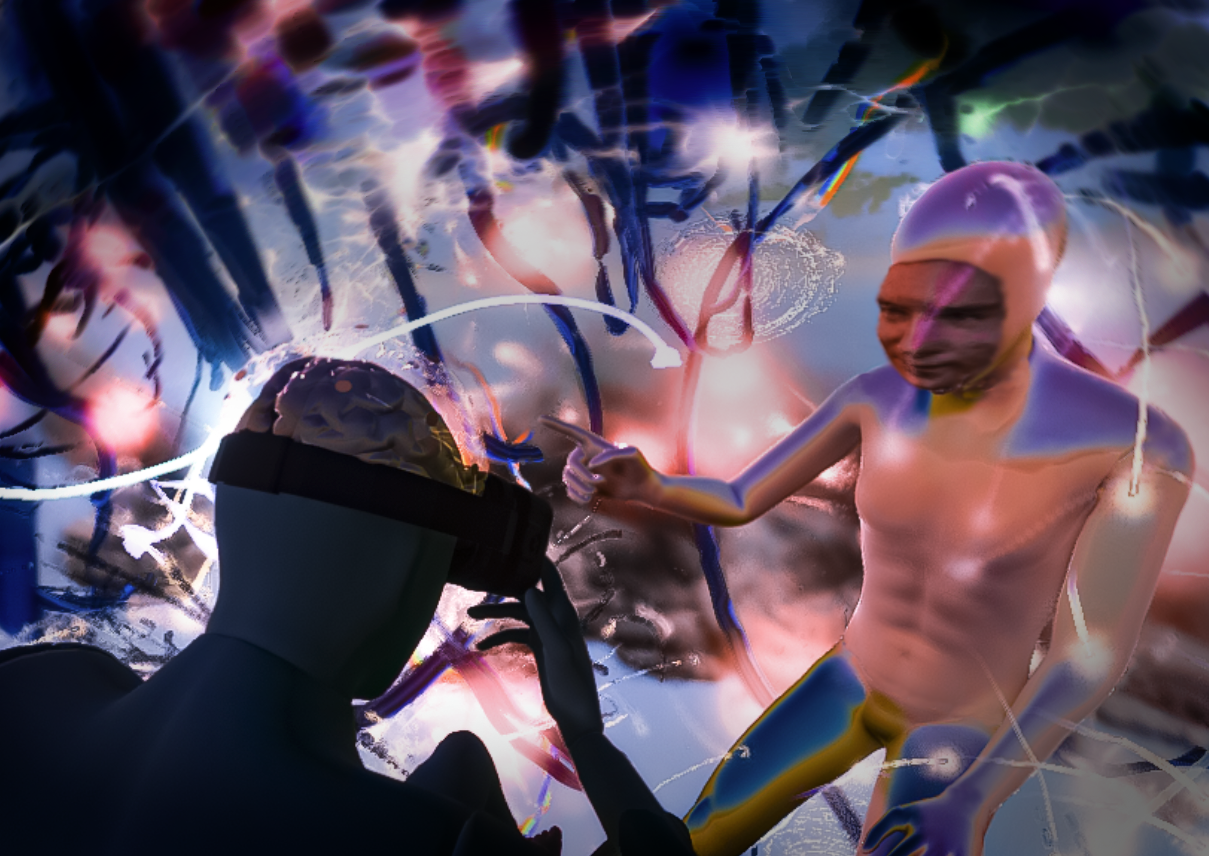
Rememberance by Chanee Choi
This work is an immersive biofeedback experience that allows one to directly manipulate virtual reality using Electroencephalography (EEG) input from a brain sensor. The mechanisms for interaction and the animation of the environment will be designed to replicate the experience of living with dementia as it advances. The goal of this project is to experiment with this process, perhaps even provide a lens through which the confusion and suffering of our loved ones with dementia can be experienced as something poetic, a process of degeneration as beautiful as it is painful. The memory of a person with dementia slowly disappears, but the brain is a sensor that continues to want to collect data. What are we then?
Context
The goal of Remembrance is to create an opportunity for an aesthetic contemplation of dementia that incorporates the current scientific understanding of the disease. The physiological mechanisms of our brains when they are fading out, as memory is lost and disorientation subsumes us relates to the perceptual qualia of all subjective experience. As in particle physics, some things are easiest to study while they are being destroyed. My work has often been, to me, an exploration of the nature of consciousness and subjective experience in the context of the possibility of concrete truth and a coherent reality, and with Remembrance I have found a way to address this topic more directly, though the poetics of dementia.
What would it be like to die softly & slowly without hope? Your appearance will be the same as others who do not have dementia, but your insides will be lost--- it starts from your eyes- your eyes will become dull first, so that people notice something is changing. Everyone who loves you will be in pain as you lose your memory, watching you recede like a flower wilting slowly, but what is more innate to life than the experience of death? The destruction becomes incandescent.
Technology
The VR game is a 1st person 3D simulation video game where players are asked to make choices that affect their storyline. I will use the feed from the player’s EEG sensors to shape the physical space that the player navigates. There is no controller in this game, but the player’s eyes will select the choices displayed. After 5 seconds of eyes focusing on a button, it will be selected. Depending on the state development of dementia, the length of time the player must look at the buttons to achieve a result will vary. As the game progresses, the player will also find it more difficult to control the character’s body as she loses spatial understanding. They will have a hard time putting a key in a lock, grabbing an apple, and petting their dog.
Electroencephalography (EEG) is the measurement of the electrical activity of the brain by electrodes placed on the scalp. Other artists have worked with EEG in the past. Alvin Lucier performed Music for Solo Performer in 1965, which is generally considered to be the first musical work to use brain waves to generate sound directly. The Digital Arts and Experimental Media department, at the University of Washington (DXARTS) founder Richard Karpen and chair Juan Pampin collaborated with the JACK Quartet in 2019 for the piece, ‘Human Subjects’, in which they generated and controlled sounds from brain waves using EEG. This DXARTS concert was what triggered my desire to explore the use of EEG headsets in my own work. DXARTS has a history of merging neuroscience and art. There are seminar classes and a lab dedicated to this hybrid field.
Interaction (or walkthrough)
When the VR begins, you enter a 360-degree spherical video, in which you find a person sitting in a chair just in front of you. This person’s body is translucent, but the contours of their face will have been created from photos of you, using a deepfake technique. This person with a face like yours will linger around you, sometimes following you or interacting with you, but gradually the screen slips, and you and this strange figure become one.
Next you find yourself in a new environment, commonplace but strange. You will move, walk, and sometimes fly while navigating this world. As you navigate the designed environment, your brain will be reacting to it’s stimuli, and through the EEG sensor your reactions will manipulate and change the animation. As time passes it will take more concentration to achieve the same effects. You may find yourself presented with challenges such as a language quiz, or whole streets might flip and rotate in front of you making coherent orientation impossible. Sometimes you won’t be able to find a key that you thought was in your backpack, and even if you do find it, the lock will seem too tight or too loose to use it. You will hear language in the background that will start out simple and familiar, but as you lose your capabilities the words will deconstruct and glitch. Slowly your existence is supplanted by that of the stranger with your face, as you recede into their transparent body and your capabilities are diminished. As you disappear they are left behind, empty.
This project is funded by a Harlan Hahn Endowment Fund Grant 2020-2021
Credit: Terrell Strong (University of Washington) as technical advisor in custom EEG and VR technology
References
Heacock, P., Walton, C., Beck, C. M., & Mercer, S. (1991). Caring for the cognitively impaired: Reconceptualizing disability and rehabilitation. Journal of Gerontological Nursing, 17(3), 23–26. https://doi.org/10.3928/0098-9134-19910301-11
Evans, D. A., Funkenstein, H. H., Albert, M. S., Scherr, P . A., Cook, N. R., Chown M. J., Herberrt, L. E., Hennekens, Charles H., & Taylor, J. O. (1989). Journal of the American Medical Association, 262(18), 2551-2556
Herrmann, N (1991). Confusion and dementia in the elderly. In Mental health and aging (pp. 35-47). Ottawa, Ontario, Canada: The National Advisory Council on Aging.
Pryse- Phillips, W ., Murray, T. J. (1986). Essential neurology (3rd ed.). New York: Medical Examination Publishing Company.
Peter V. Rabins (2006), Practical dementia care, Oxford ; New York : Oxford University Press
Donald F. Scott (1976), Understanding EEG : an introduction to electroencephalography, Philadelphia : Lippincott
Sicong Tu, Stephanie Wong, John R Hodges, Muireann Irish, Olivier Piguet, Michael Hornberger, Lost in spatial translation - A novel tool to objectively assess spatial disorientation in Alzheimer's disease and frontotemporal dementia, PMID: 25913063 DOI: 10.1016/j.cortex.2015.03.016
Thomas A Deuel, Juan Pampin, Jacob Sundstrom, Felix Darvas, The Encephalophone: A Novel Musical Biofeedback Device using Conscious Control of Electroencephalogram (EEG)
PMID: 28491030 PMCID: PMC5405117 DOI: 10.3389/fnhum.2017.00213
Bibliography
Jeffrey L. Cummings (1948), The neuropsychiatry of Alzheimer's disease and other dementias, 2002 London
Mary Kaplan, Stephanie B. Hoffman, Behaviors in dementia : best practices for successful management, 1998 Baltimore : Health Professions Press

