Soilcraft is a design thesis exploring possible futures for damaged landscapes through imaginative nomenclature and textile-based objects


The DXARTS SoftLab is a studio and an online platform whose mission is to examine the role of workmanship in artistic research, to redefine the use of crafting in the post-digital era, and to explore the body as an interface of control and resistance. It is part of the Department of Digital Arts and Experimental Media (DXARTS) at the University of Washington in Seattle.
Soilcraft is a design thesis exploring possible futures for damaged landscapes through imaginative nomenclature and textile-based objects
Responding to current concerns about the ubiquity of voice assistants, this artistic research by Afroditi Psarra, Audrey Desjardins, and Bonnie Whiting, focuses on building a series of performative artifacts that aim to challenge AI and ML technologies, and to examine automation through the prism of “ghost work” that constantly support these systems.
Artist talk at Fabricademy 2020-21 on current e-textiles research, cyberfeminist experiments, and the idea of embodiment through hacking technical artifacts.
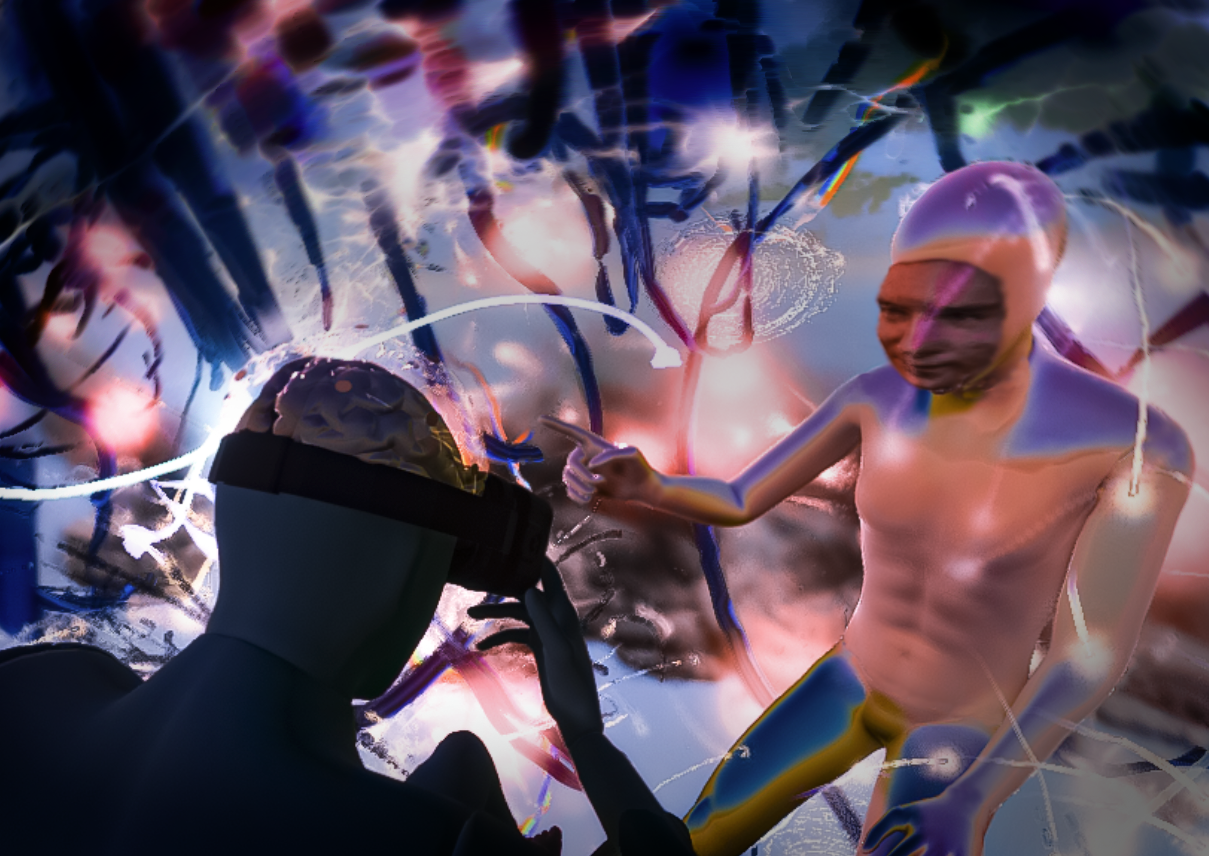
Remembrance, Customized EEG, VR hat with multi-interactive immersive installation by Chanhee Choi (2020-2022)
Listening Space mini documentary and online performance at the 26th International Symposium of Electronic Art which took part in Montreal during October 13-18, 2020
Our Networks is a conference about the past, present, and future of building our own network infrastructures. This year’s topic was Growing Our Networks in Uncertain Times↔Places and the conference took place online during September 8–12, 2020
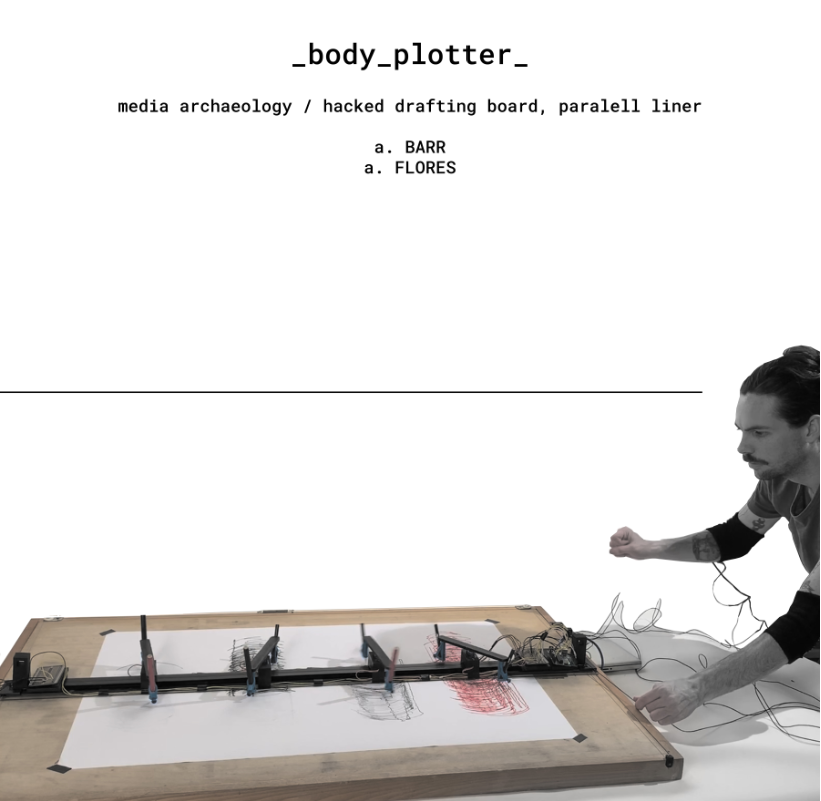
A prototype that hacks the ancient language and tools of the architect to radicalize novelty, performance, and experimentation as a design process
An e-textile that explores how technology, sound, and movement can reimagine the body’s relationship to space and ‘A’rchitecture.
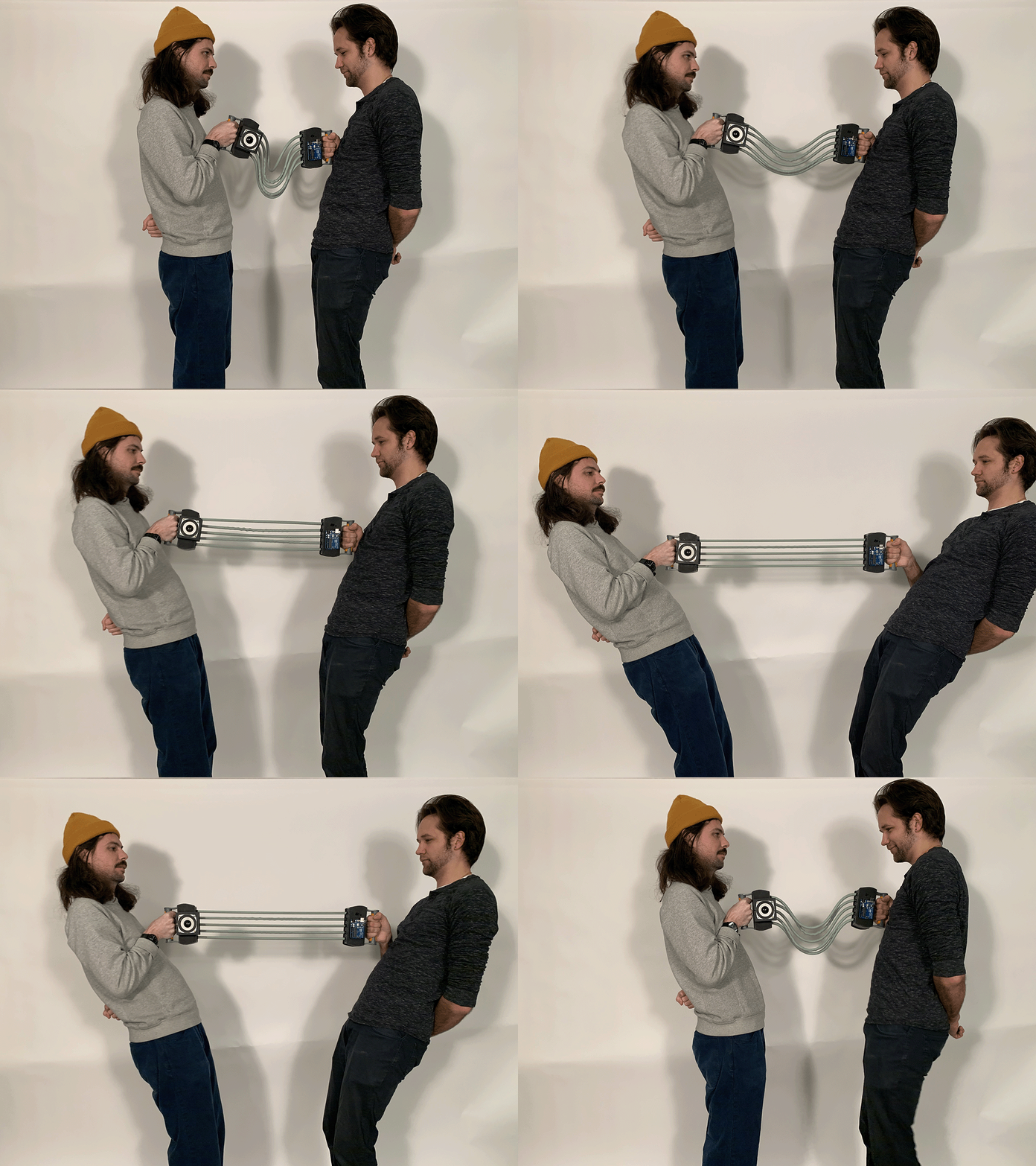
A prototype that challenges the role of toxic masculinity through media archaeology and performance.
Emotive-textiles explores the relationship between feelings and tactile sensations. Playing with the experience of touch, this project presents a series of tangible emotions through a half-traditional and half-digital crafting process.
An online sound installation between Afroditi Psarra and Stefan Tiefengraber during the COVID-19 lockdown, exploring copper mesh roll, to create antennas and circuits that can pick up and amplify the electromagnetic transmissions of our intimate spaces in Seattle and Linz.
This e-textile explores embodiment through site and body. Using a module system (to continue the possibilities in the future), connecting the microprocessor “belt” to gloves with capacitor sensors to create an electromagnetic field that measures the distance of objects. Its output is a speaker that illuminates the experience of space and body through sound.
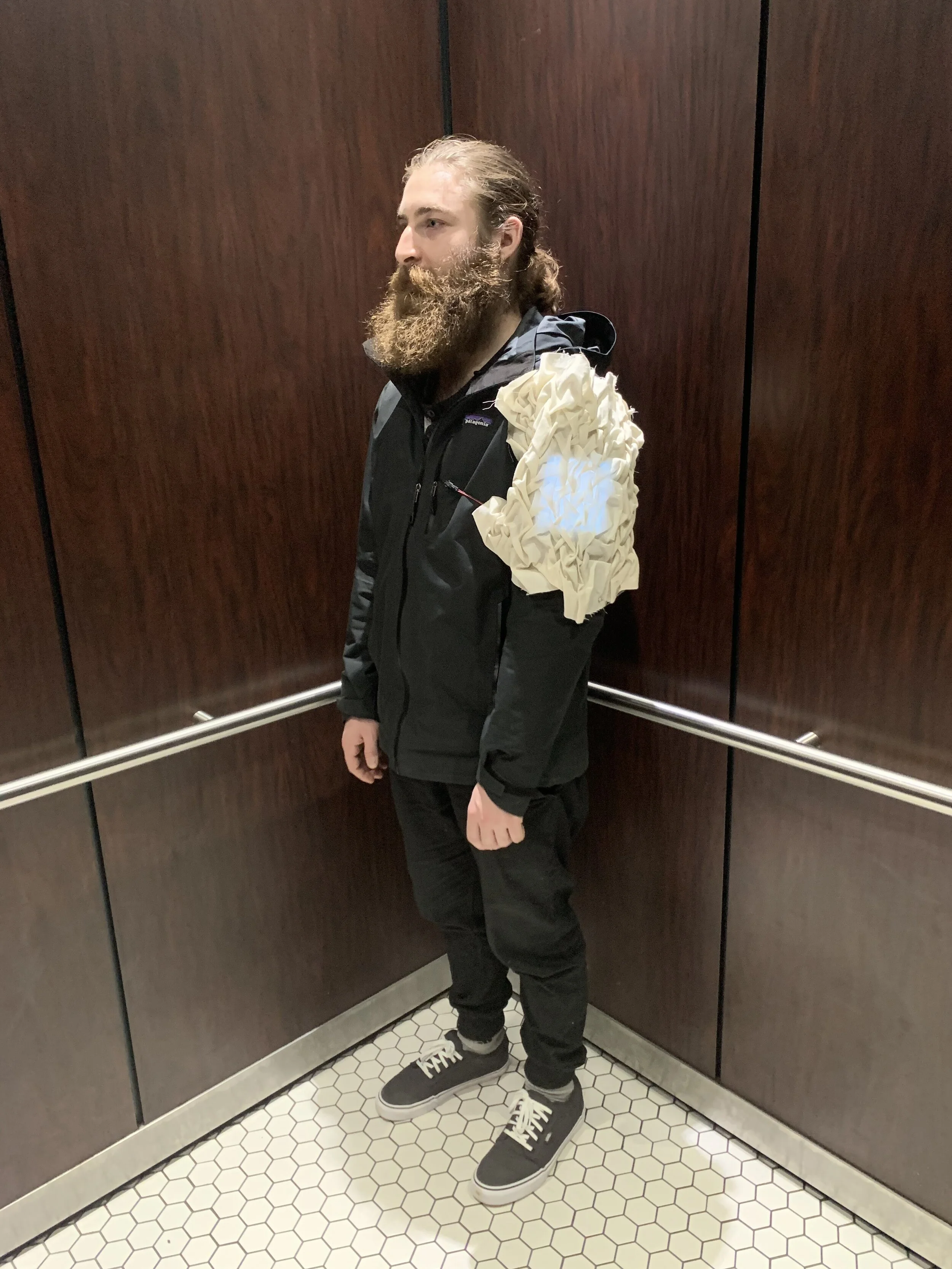
This project probes the topic of personal space through artistic and design-based inquiry, by exploring the process of smocking fabrics as a mode of data analysis.
Aftermath of the ISWC (International Symposium of Wearable Computers) and the Textile Intersections Conference, that took place in London, UK, on Sept 11-13 and Sept 12-14, 2019 accordingly.
The High Water Pants were designed as a tool to speculatively explore the intersections of everyday cyclists and climate change and were the main design object from my master of design thesis. They are a ‘time-bending’ garment for cyclists to wear that enable future projections about sea-level rise to be experienced in the present moment, in situ, as cyclists ride and explore Seattle’s unique geography and topography.
This sound performance titled Racquetball Score,which explores gender non-binary-ness through soundscapes strategically sourced through a game of racquetball using live feedback and embedded piezo mics.
An introductory workshop on the world of e-textiles and soft-circuits at S1 Synth Library in Portland.
RBG sensor, electromyographic sensor, motor, and leds embed within my future skin for activation and protection. Entering upon a new spaces, the RBG sensor reads the aura of the room and sends that information through my new veins and communicated through lights. Sound is trigged from the electromyorphic information that my right arm indicates while taking in the colors.
On June 6th 2019, Isabel Nelson and several other students from the DXARTS 490 E-textiles and Wearables for Art and Design course, as well as other emerging designers from the University of Washington got together to produce Hypnotica, a wearable tech fashion show at the project space Hyena Culture in downtown Seattle, at the historic Pioneer Square district. The event was entirely self-organized and combined fashion, light art, sound and performance art and was presented through an exciting runway show that showcased the work of Taylor Hammes, Aashna Dev, Aarohi Bhaway, Atari Women, Esther Lin, Helen Mirabella, Grace Barar, Stevie Koepp, Kennedy Buriani, Rebby Montalvo, and of the main organizer Isabel Nelson.
On June 2019, in the fourth edition of DXARTS 490A: E-textiles & Wearable studio class, students presented their final project prototypes through a pop-up exhibition at the DXARTS Fablab in Ballard.