Soft Data and Common Wares Residency: elderberry cyber ritual by Cathryn Ploehn
I created an (offline-first) elderberry cyber ritual for practicing gratitude. Intended for use in quiet everyday moments (of individuals or small groups), the ritual aims elevate previously ephemeral entanglements of care through a (low-fidelity, bioregionally situated) elderberry-based interface for reflecting and archiving (local, embodied) records of gifts as digital "berries."
This residency builds on previous work done in partnership with Festival Beach Food Forest (FBFF), a volunteer-run, radically inclusive permaculture project on a public park in Austin, Texas: the experimental commons.

Since 2021, I have been embedded as a volunteer at FBFF. In 2022, I facilitated a project for collecting stories (data) about gifts received at FBFF. Our project aims to elevate our community's lived experiences of "staying with the trouble" (Haraway 2016) or "happenings through contamination" (Tsing 2015) in the struggle to cultivate livability. I completed an elderberry botanical simulation to visualize the data through the hyperlocal visual language of gifts made embodied through berries.
This data visualization tells the stories of gifts received through the nourishing and healing elderberry; a bioregionally (and ethnobotanically) significant plant. My l-system simulates the branching of elderberry clusters, crafted through hours of close observation of (and laboring for and kinship with) FBFF elderberry shrubs. The elderberry coordinate system tells us how these plants (who stabilize the riparian thickets of Texas Blackland Prairies and nourish countless birds) structure space, queering the grid away from Cartesian rationalism. Your cursor is a female Cardinal who feasts upon these digital gift berries as you explore the data.
In this residency, I aimed to extend this data viz into an everyday ritual of archiving. I wonder how the figure of elderberries might inform an embodied, everyday practice of gratitude.
How might the visceral joy of eating and preserving digital elderberry gifts aid us in building the critical (yet quotidian) practices of noticing, in service of ecological kinship and collective care?
background: gratitude as world-making practice
This year, my therapist recommended I begin a gratitude practice to cope with my anxiety disorder. Noticing the gifts that sustain us—networks of care—is critical. Gratitude not only calms the nerves (Rash 2011, Emmons 2013, Watkins 2015, Jackowska 2016, Armenta 2017) but begins to disabuse us of our feelings of isolation through elevating entanglements of care Fredrickson 2004, Desteno 2010, Bartlett 2012, Layous 2017).
Despite its pervasiveness in my own networks and beyond, I used to think my own anxiety disorder emerged only out of my own personal circumstances. However, gratitude reveals invisibilized systems of care, asking us to question the systems of power that manufacture conditions for pervasive (but often individualized) anxiety (Plan C, 2014).
Beyond problematizing the invisibility of care, gratitude can also link us to local (and global) webs of relatedness. Gratitude is one fulcrum by which we can learn about who makes our localities livable, such that we, in turn, can contribute to those commons (Block 2008, Kimmerer 2013, Hyde 2019). Gratitude, through (re)connecting us to the reciprocity required for mutual care, might be a central skill for repair in our contemporary era of social and ecological crisis (Tam 2022, Kimmerer 2024).
As a skill cultivated through practice, can gratitude elevate invisabilized labor and call us to participate in acts of cultivating livability ourselves?
Alternative permacomputing practices and interfaces
How can the softness of gratitude be maintained through interaction design and data visualization; industries whose conventions extract data via digital labor with atomizing and efficient interface paradigms?
Also inspired by movements and ideas like sapphirepunk, permacomputing, lo-fi manifesto, digital degrowth, and offline-first, I wonder what alternative aesthetics of interaction can hedge against the extractive and anxiety-inducing tendencies of digital labor (a dominant force in many of our lives, including mine).
At the same time, I wonder how the same aesthetics can attend to the material impact of computation (labor and land exploitation), often invisibilized through sleek interfaces. How can a berry-based interface and reclaimed electronics counter these tendencies through slowness, constraints, and relationality?
new interfaces for data "born hyperlocal"
In anticipation of the hyperlocal theme of the residency, I read Archiving Machines (Acker 2025), which explores the historical diminishment of our data sovereignty through interfaces that enforce material and indexical distance (in other words, removal of context) from our data. In part, data about us is "born networked." Inspired by this text, I resolved to experiment with interfaces that embrace the hyperlocal via this prism of questions:
How can bioregional metaphors show and enforce a hyperlocal indexicality of data?
What frictions can reconnect us to the politics and poetics of making records for a digital archive?
How can we question grammars of action that underpin data as "born networked" through new metaphors that attempt to enforce data "born bioregional" and "put to rest"?
elderberry interface patterns
In my previous work, gifts data is visualized using an elderberry branch generated by an L-system I developed through close observation of American Black Elderberries (Sambucus canadensis) that reside in Festival Beach Food Forest, a permaculture project on a public park in my hometown of Austin, Texas.
Elderberry branches are fractal; self-similar at different scales. The pattern that repeats at different scales is what I call the elderberry quantum. In technical terms, running through the rules of the L-system once will produce the elderberry quantum.
Working with Javascript (paper.js and p5.js) and a metaball algorithm created by paper.js and Sato Hiroyuki, I created code for showing the elderberry quantum in a grid.


Using this elderberry quantum, I experimented with many interfaces for, in Natasha Meyer's words, "vegetalizing your sensorium" in the tune of the elderberry: trace to unlock, a custom dither machine, and (in partnership with DXARTs PhD student Maggie Ma) a phone stand.
trace to unlock
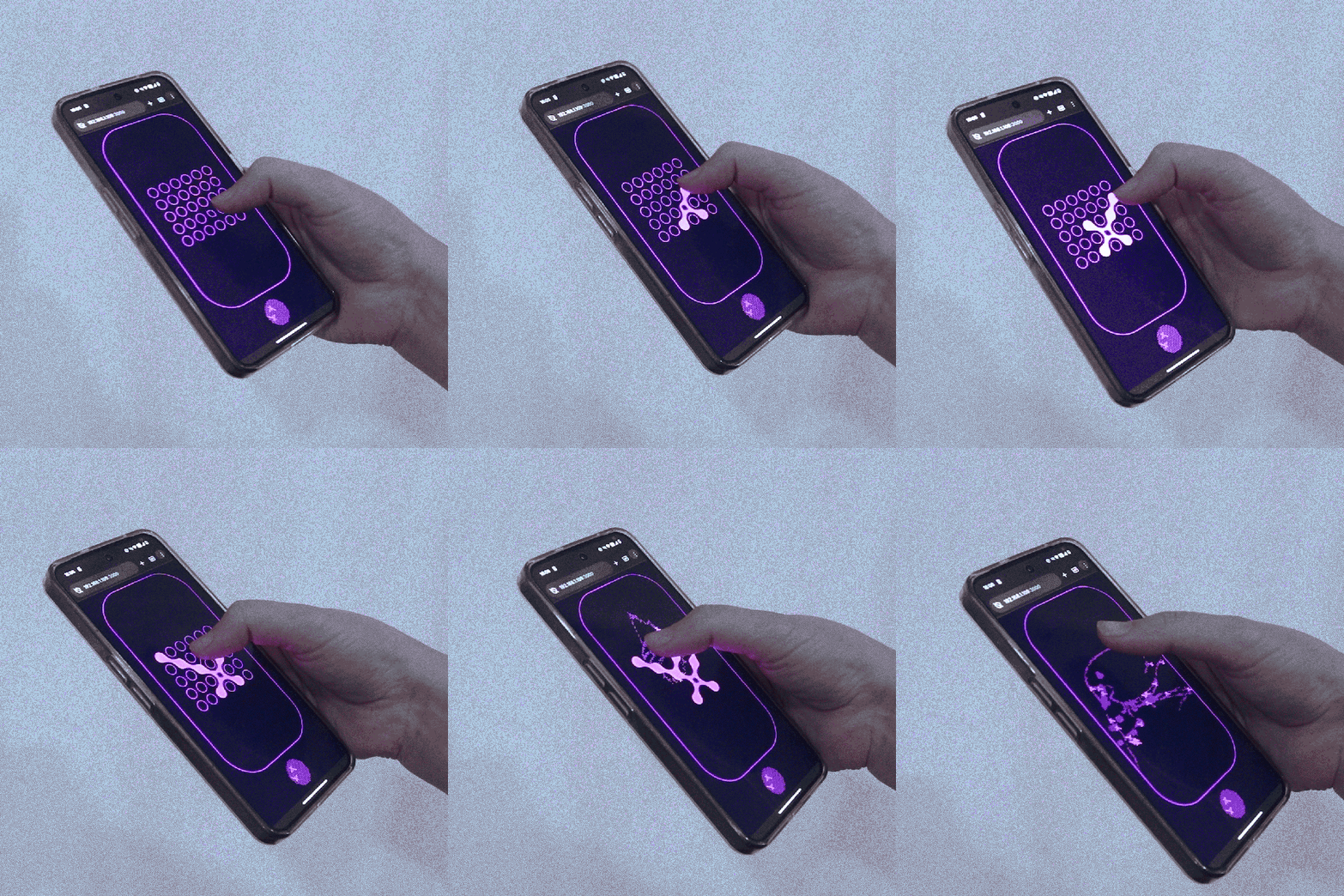
I reimagined a mobile password pattern screen that requires tracing the elderberry quantum to unlock and use my system on your mobile device.
This UI pattern frames the elderberry branching pattern as a special secret, enforcing an embodied knowledge of this hyperlocal plant.
Unlike the classic pattern unlock gesture, this interface draws one connection between grid points at a time. This affords the creating a branching structure.
dither machine
I explored ways to tesselate / tile the elderberry quantum in a space, creating code for dithering / compressing images into elderberry-based "pixels."


This dither reframes the world / images through the vision of the care networks that sustain us; the gifts they embody (elderberries), or the potential for the giving of gifts (seeds).
Most interface graphics were dithered using this machine. Such dithering techniques show a "care for hardware" (a permacomputing principle) by reducing the data (and thus power) required to operate my system.
phone stand
Taking the elderberry quantum as inspiration, Maggie Ma created an elderberry phone stand that activated the data visualization via an embedded RFID tag.

fiber traces
Thankful for this opportunity to use fiber art machinery, I used the embroidery machine to create elderberry quantum patterns. Sadaf Sadri was kind enough to host an embroidery workshop that let us grow accustomed to working with the machine.
Adapting the same code from the dither machine, I played around with creating embroidery files for the machine using the open source library p5.embroider. Ultimately, I worked with Sadaf to produce the files for the machine using its native software.
Some of the elderberry patterns are made using conductive thread, which afford them to be connected into / activate the rest of the system.


bird digestion
In the months before the residency, I filmed birds visiting a window-mounted birdfeeder, growing an appreciation for these same species of birds (mostly cardinals) who also feast on elderberries in late summer. I used those clips to create rotoscope tracings of these birds to produce interfaces following the consumption, digestion, and defecation of an elderberry (or its resident seed).

search for local traces of care
Upon arriving in Seattle, I sought traces of the networks of care that sustains both ecology and people in the city.


land stewardship
The day after landing in Seattle, my first stop the very next morning was Beacon Food Forest (BFF), a volunteer-run permaculture project on a public park in Seattle. Just like Festival Beach Food Forest, its an project committed to recultivating citizen's capacity for caring for land and people. I volunteered multiple times over my residency, developing a familiarity with new ethnobotanically and ecologically significant flora.


finding the blue elderberry
In tracing Seattle's networks of care, I aimed to study the branching patterns of the blue elderberry (Sambucus cerulea), which is a decidedly regional plant. It does not grow in my home ecoregion around Austin, only residing in the western half of the United States.
Finding this species of elderberry was unexpectedly difficult.
Initially, I would follow leads on iNaturalist as little everyday sidequests, going to places where people had spotted the blue elderberry before. After two fruitless weeks, I decided to exhaust all the remaining iNaturalist leads while also visiting some of the major ecological spots. An entire day (and walked 28 thousand steps later), I had seen some of the most gorgeous collections of local and international plants, including my first ever encounter with a Serviceberry.


However, I didn't encounter a blue elderberry until days later, randomly seeing one in the edge of a parking lot near (but not inside of) the UW medicine garden. I took some isolated photographs of the clusters.


In the last week of the residency, I did an initial analysis of the blue elderberry’s quantum branching pattern. I gave a tutorial to the DXARTS Soft Lab on my approach to creating an L-system based on specific species of plants.


local materials
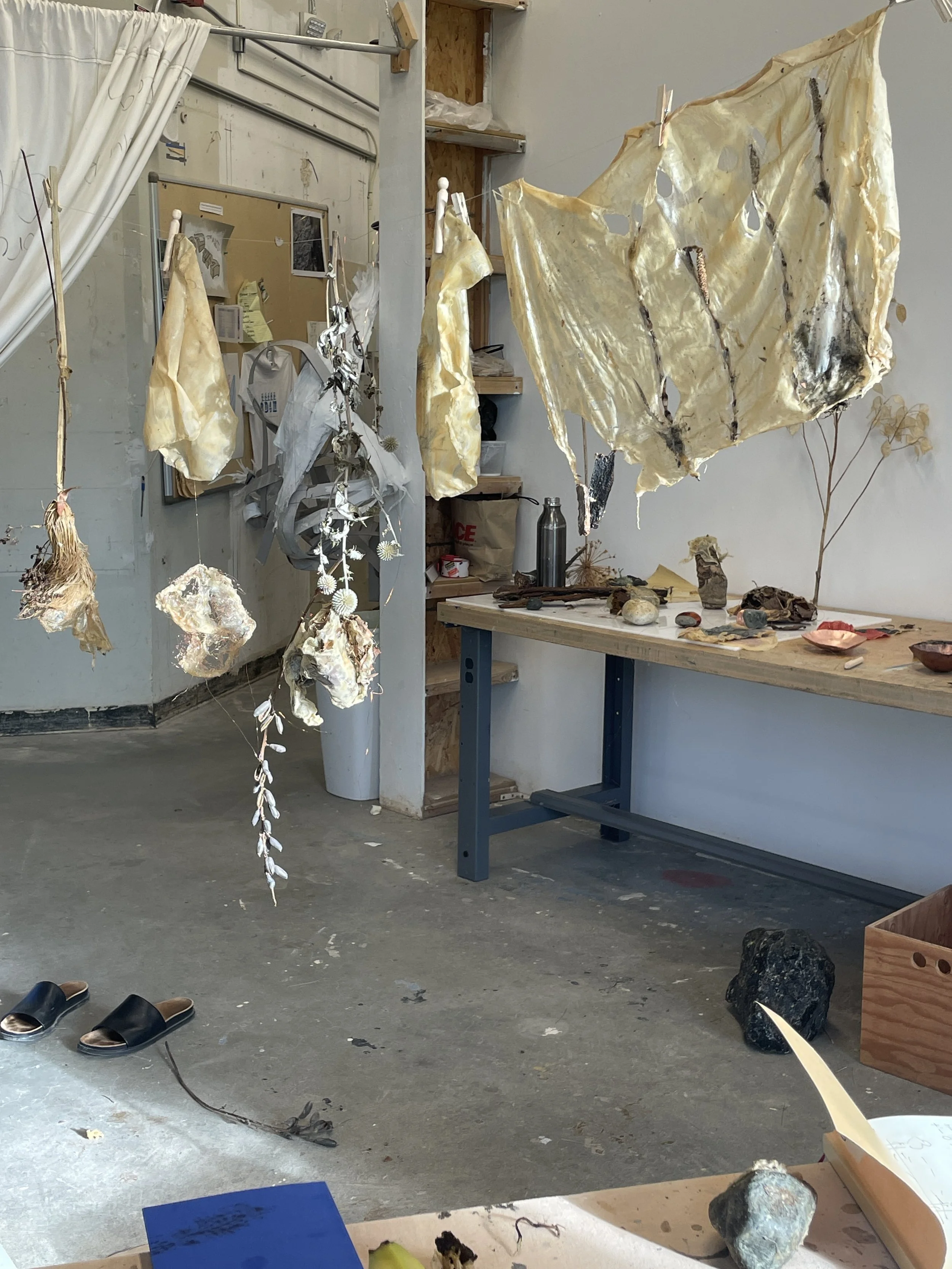
In the spirit of permacomputing (and using as few new materials as possible) I visited the legendary RePc and Seattle ReCreative. I picked up a stand for my Raspberry Pi, paper, pens, and materials to attempt embroidery with.


sharing the prototype
On the last week of the residency, I was thankful to receive feedback for my freshly created prototype draft with both Audrey's creative research group and exhibit the work in Survival and Transformation, a group show organized by Tivon Rice at the UW Greenhouse.

Sources cited
Acker, Amelia. Archiving Machines: From Punch Cards to Platforms. The MIT Press, 2025. The Information Society Series.
Armenta, Christina N., et al. “Functions of Positive Emotions: Gratitude as a Motivator of Self-Improvement and Positive Change.” Emotion Review, vol. 9, no. 3, July 2017, pp. 183–90. DOI.org (Crossref), https://doi.org/10.1177/1754073916669596.
Bartlett, Monica Y., et al. “Gratitude: Prompting Behaviours That Build Relationships.” Cognition & Emotion, vol. 26, no. 1, Jan. 2012, pp. 2–13. DOI.org (Crossref), https://doi.org/10.1080/02699931.2011.561297.
Block, Peter. Community the Structure of Belonging. Second edition., Berrett-Koehler Publishers Inca BK Business book, 2008.
DeSteno, David, et al. “Gratitude as Moral Sentiment: Emotion-Guided Cooperation in Economic Exchange.” Emotion, vol. 10, no. 2, 2010, pp. 289–93. DOI.org (Crossref), https://doi.org/10.1037/a0017883.
Emmons, Robert A., and Michael E. McCullough. “Counting Blessings versus Burdens: An Experimental Investigation of Gratitude and Subjective Well-Being in Daily Life.” Journal of Personality and Social Psychology, vol. 84, no. 2, Feb. 2003, pp. 377–89. DOI.org (Crossref), https://doi.org/10.1037/0022-3514.84.2.377.
Fredrickson, Barbara L. “Gratitude, Like Other Positive Emotions, Broadens and Builds.” The Psychology of Gratitude, edited by Robert A. Emmons and Michael E. McCullough, Oxford University Press, 2004, pp. 144–66. DOI.org (Crossref), https://doi.org/10.1093/acprof:oso/9780195150100.003.0008.
Haraway, Donna J. Staying with the Trouble: Making Kin in the Chthulucene. Duke University Press, 2016, p. dup;9780822373780/1. DOI.org (Crossref), https://doi.org/10.1215/9780822373780.
Hyde, W. Lewis. The Gift: How the Creative Spirit Transforms the World. Knopf Doubleday Publishing Group, 2019.
Jackowska, Marta, et al. “The Impact of a Brief Gratitude Intervention on Subjective Well-Being, Biology and Sleep.” Journal of Health Psychology, vol. 21, no. 10, Oct. 2016, pp. 2207–17. DOI.org (Crossref), https://doi.org/10.1177/1359105315572455.
Kimmerer, Robin Wall. Braiding Sweetgrass: Indigenous Wisdom, Scientific Knowledge and the Teachings of Plants. Milkweed Editions, 2013.
Kimmerer, Robin Wall. The Serviceberry: Abundance and Reciprocity in the Natural World. With John Burgoyne, 1st ed, Scribner, 2024.
Layous, Kristin, et al. “What Triggers Prosocial Effort? A Positive Feedback Loop between Positive Activities, Kindness, and Well-Being.” The Journal of Positive Psychology, vol. 12, no. 4, July 2017, pp. 385–98. DOI.org (Crossref), https://doi.org/10.1080/17439760.2016.1198924.
Rash, Joshua A., et al. “Gratitude and Well‐Being: Who Benefits the Most from a Gratitude Intervention?” Applied Psychology: Health and Well-Being, vol. 3, no. 3, Nov. 2011, pp. 350–69. DOI.org (Crossref), https://doi.org/10.1111/j.1758-0854.2011.01058.x.
Tam, Kim-Pong. “Gratitude to Nature: Presenting a Theory of Its Conceptualization, Measurement, and Effects on pro-Environmental Behavior.” Journal of Environmental Psychology, vol. 79, Feb. 2022, p. 101754. ScienceDirect, https://doi.org/10.1016/j.jenvp.2021.101754.
Tsing, Anna Lowenhaupt. The Mushroom at the End of the World: On the Possibility of Life in Capitalist Ruins. Princeton University press, 2015.
Watkins, Philip C., et al. “Grateful Recounting Enhances Subjective Well-Being: The Importance of Grateful Processing.” The Journal of Positive Psychology, vol. 10, no. 2, Mar. 2015, pp. 91–98. DOI.org (Crossref), https://doi.org/10.1080/17439760.2014.927909.
We Are All Very Anxious – We Are Plan C. 2014, https://www.weareplanc.org/2014/04/we-are-all-very-anxious/.